Weekly Heat
🏆 Draw One Line Weekly Challenge
Push your best Draw One Line score this week. Top runs appear below — beat them, favorite the game, and share your result with friends.
Resets each Monday · Official cups also run on Sudoku, 2048, Type Racer & Word Chain
📅 This Week’s Top Draw One Line Scores
Live weekNo weekly scores yet for Draw One Line.
Be first on the board — finish a run and your score can appear here.
TOP SCORES
Game Guide
Draw One Line — Complete Guide
Learn Draw One Line on Arkade Game: how one-stroke tracing works, node theory for finding a valid path, every mode from Beginner to Expert, and solving tips.
About the Game
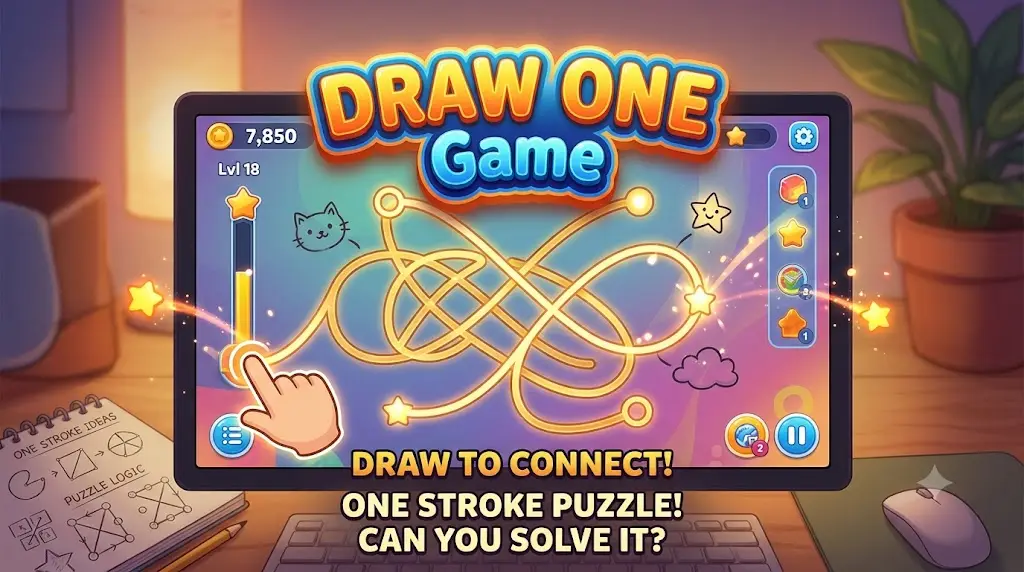
Draw One Line asks you to solve a deceptively simple challenge: trace every line in a glowing procedural shape using one continuous, unbroken stroke. Every puzzle is a network of nodes connected by edges, and your task is to find a path through that network that uses each edge exactly once without ever lifting your finger or mouse.
It is a puzzle format with real mathematical roots — the same logic behind the classic "seven bridges" style of problem — but here it shows up as a calm, glowing canvas puzzle rather than an abstract math exercise. The difficulty scales from shapes a beginner can solve by instinct up to expert networks that genuinely reward understanding why some paths are impossible and others are not.
Because every shape is generated procedurally rather than pulled from a fixed bank, the game can keep producing fresh networks indefinitely, which means pattern memorization from a previous puzzle rarely transfers directly to the next one you load. What does transfer, however, is the underlying reasoning skill — recognizing which nodes and branches actually constrain a valid path — and that intuition compounds noticeably over dozens of solved puzzles.
How to Play
Pick a mode, or use level packs on the hub to filter by theme, then load a puzzle. Press and hold the highlighted start node, then drag through the connected paths in one continuous motion, watching the live edge counter, progress bar, and timer as you go. Every edge you cross dims to show it has been traced, and the goal is simple: dim every single edge without ever lifting your input device. Release only after the entire network glows as complete, then collect stars, coins, and XP before moving on.
Controls
- **Press and drag** — trace connected edges with mouse or finger
- **U** — undo a wrong turn
- **H** — request a hint when stuck
Objective
Trace every line exactly once in one continuous stroke, connecting the highlighted start node through the entire network without lifting your input device or repeating an edge until the whole shape glows as complete.
Beginner Tips
- Look for odd-degree nodes — they often mark where a valid trail must begin or end.
- Solve dangling branches first so you do not trap yourself in a spur later.
- Move with slow, steady drags rather than fast zig-zags, especially on mobile.
- Use Undo instead of lifting — lifting ends the run immediately.
Advanced Strategies
The single most useful piece of solving knowledge is recognizing odd-degree nodes — points where an odd number of edges meet. A valid single-stroke trail can only begin or end at a node with an odd number of connections, so if a shape has exactly two such nodes, your path must start at one and end at the other. If every node has an even number of connections, you can start anywhere and the path will naturally close every loop.
Common Mistakes
- Treating dangling spurs as optional detours instead of tracing them first or last.
- Moving too fast on touch devices, causing accidental lifts that end an otherwise correct attempt.
- Burning hints early instead of spending a moment identifying odd-degree nodes.
- Picking a starting node because it looks visually prominent rather than because it is actually odd-degree.
Winning Techniques
Repeated exposure to these puzzles gradually builds an intuitive sense for shapes that are solvable at a glance versus ones that need deliberate node-counting. Experienced players recognize recurring local structures — a small loop attached to a single connecting edge, for instance — and instinctively know how those structures need to be handled within a larger path.
Mobile Tips
Use slow, deliberate drags rather than fast motions, since a quick zig-zag can accidentally lift your finger and end the attempt. Press firmly on the highlighted start node before beginning your drag to make sure the stroke registers from the correct point.
Keyboard Shortcuts
U undoes your last traced segment, and H requests a hint revealing the next recommended edge. There are no directional key controls, since the entire mechanic is built around a continuous drag rather than discrete movement.
Features
- Procedurally generated shapes for endless fresh puzzles
- Odd-degree node logic rooted in real graph theory
- Beginner through Expert difficulty plus Speed and Zen modes
- Daily Challenge with a shared puzzle
- Undo and limited Hint tools
Game Modes
Beginner through Expert scale up in edge count and network complexity. Speed mode keeps puzzles moderate in size but adds real time pressure, rewarding players who recognize a valid starting node quickly. Zen mode removes the timer entirely for relaxed practice, Daily Challenge loads one shared puzzle for every player on a given day, and Endless Random keeps generating fresh procedural shapes back to back.
Frequently Asked Questions
**How do I complete a puzzle?** Press and hold the highlighted start node, then drag through connected paths until every edge is traced exactly once. **Why can a path only start or end at an odd-degree node?** Passing through a node uses two connections at a time, so an odd-degree node always leaves one connection unpaired at the start or end. **Why solve dangling branches first or last?** Leaving one mid-path traps you since you can't retrace the single edge back in. See the full FAQ list below for hint limits and Daily Challenge details.
Final Thoughts
Draw One Line rewards a specific kind of thinking — spatial reasoning paired with a bit of graph theory intuition — without ever feeling like homework, because the glowing canvas and satisfying stroke animation keep every solve visually rewarding. It runs free in your browser and scales from a two-minute Zen puzzle to a genuinely tough Expert network depending on your mood that day.
Explore more in all free online games or jump to Pipe Connect, Gravity Maze, Spot The Difference . Strategy write-ups also live on the Arkade Game blog.
🎮 Why You'll Love This Game
You’ll love Draw One Line for one continuous stroke that has to cover every segment once. Trace every line exactly once in one continuous stroke — and Arkade Game keeps progress with XP, coins, and leaderboards so every short session still counts.
🧠 Skills You Improve
-
Logic 5/5
-
Memory 3/5
-
Speed 2/5
-
Strategy 4/5
-
Reflexes 1/5
📈 Difficulty Meter
Medium · Easy–Expert
⏱ Average Match Time
5–12 minutes
🔥 Trending Score
68/100
🆕 Last Updated
⭐ Best For
🏆 Community Challenges
- Complete today’s daily challenge for Draw One Line and claim streak rewards.
- Solve today’s puzzle under the suggested move count.
- Finish one harder difficulty without using hints.
📊 Player Statistics
- All-time plays
- 248
- Player rating
- No votes yet
- Top score
- 1,248
- Category
- puzzle
🎯 Related Games
More titles that pair well with Draw One Line.


Guides & Blog Articles
Strategy deep-dives live in the Blog — not mixed into other site areas.
Best Puzzle Games Online: Top Picks for Every Skill Level
From Sudoku and 2048 to Nonogram and Gravity Maze — discover the best puzzle games online and learn how daily...
Read article →Brain Games for Adults: Stay Sharp with Daily Play
Discover the best brain games for adults — Sudoku, Chess, Memory Matrix, Wordle, and more — and build a daily...
Read article →