Weekly Heat
🏆 Sling Siege Weekly Challenge
Push your best Sling Siege score this week. Top runs appear below — beat them, favorite the game, and share your result with friends.
Resets each Monday · Official cups also run on Sudoku, 2048, Type Racer & Word Chain
📅 This Week’s Top Sling Siege Scores
Live weekNo weekly scores yet for Sling Siege.
Be first on the board — finish a run and your score can appear here.
TOP SCORES
Game Guide
Sling Siege — Complete Guide
Learn how to play Sling Siege on Arkade Game — aiming rules, controls, beginner tips, advanced physics strategy, and frequently asked questions.
About the Game
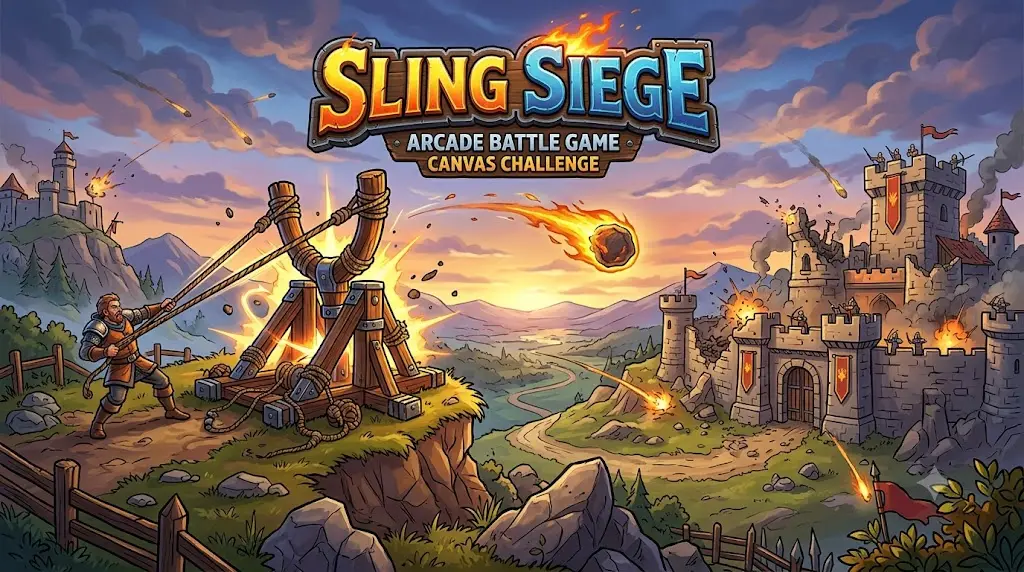
Sling Siege takes the timeless satisfaction of a well-aimed slingshot shot and builds an entire puzzle format around it. Each level presents a fortified structure made of blocks and enemy troops, and your only tool is a slingshot with a limited number of shots. Pull back, aim carefully, and release — then watch physics take over as your projectile crashes through timber, stone, or whatever material the fort happens to be built from.
What makes the format compelling is how much depth exists inside such a simple control scheme. There is no movement, no inventory, and no upgrade tree to manage mid-level — just the angle and power of your pull, and the layout of the fortification in front of you. That constraint forces genuine problem-solving. A fort that looks unbeatable with a flat, direct shot often falls apart in one clean hit once you notice the weak support beam holding the whole structure together, or the angle that lets one projectile bounce through several targets in sequence.
Chain reactions are where Sling Siege earns its replay value. Toppling one section of a fort into an adjacent section, so that a single shot clears far more than it directly touched, feels genuinely clever every time it works. Higher levels lean into this by designing increasingly elaborate fortifications specifically so that the "obvious" shot only clears part of the target, while a smarter angle triggers a cascade that finishes the whole level in far fewer attempts.
Because shots are limited on every level, Sling Siege also rewards patience over impulsive aiming. Rushing a shot before fully reading the structure's layout is the single most common way to waste a precious attempt on a level that actually had a clean, efficient solution waiting to be found. The best players treat each level as a short puzzle to study before committing to a shot, rather than a pure reflex challenge.
How to Play
- Tap to start a level, then drag backward on the slingshot to set your aim and power.
- Release to launch the projectile at the enemy structure and troops.
- Watch the physics play out as blocks topple, break, or trigger chain reactions into neighboring sections.
- Destroy every target on the level using your limited number of shots.
- Advance to tougher fortifications as levels progress, where planning chain reactions becomes essential.
Controls
Sling Siege uses a single, intuitive drag-and-release control scheme. Click or tap on the slingshot and drag backward to set the angle and power of your shot — pulling farther back increases both the launch speed and distance. Releasing your mouse button or lifting your finger fires the projectile immediately along the aimed trajectory. No other controls are needed to play a full level from start to finish.
Objective
The objective on every level is to destroy all enemy structures and troops using the limited number of shots provided. Some levels can be cleared with a straightforward, direct approach, while others are specifically designed to require a chain reaction or an indirect angle to finish within your shot limit.
Beginner Tips
- Take a few seconds to study the full fort layout before your first shot rather than firing immediately.
- Start with lower-power pulls on your first attempt at a new level to get a feel for how far a given pull distance actually launches the projectile.
- Look for obviously unstable sections, like blocks stacked precariously or unsupported overhangs, since these usually indicate an intended chain-reaction opportunity.
- Don't panic if your first shot on a level misses — most levels are designed with a small margin for a recovery shot.
- Replay easier early levels once you understand chain reactions better, since your original clear may not have been the most efficient one available.
Advanced Strategies
- Identify the single structural element holding the most weight in a fort, and aim to remove it first so gravity does the rest of the work for you.
- Use a flatter, faster trajectory to punch through multiple thin barriers in a single shot rather than arcing over them.
- Save a slightly higher-power pull for the final target on a level, since remaining troops or blocks are often positioned to require more direct force than earlier ones.
- Practice consistent pull distances so you can reliably reproduce a specific power level once you find an angle that works.
- When a level feels impossible with a direct approach, deliberately look for an indirect bank shot off a nearby wall or structure instead.
Common Mistakes
- Firing a shot before fully studying the fort's layout and support structure.
- Pulling back with maximum power on every shot regardless of the target's distance, which often overshoots closer structures.
- Ignoring visibly unstable sections that were clearly designed as a chain-reaction opportunity.
- Wasting shots repeating the same failed angle without adjusting for what you learned from the miss.
- Rushing through easier levels without noticing more efficient chain-reaction solutions that would help on harder levels later.
Winning Techniques
Consistently clearing levels efficiently comes down to treating each fort as a short structural puzzle rather than a target range. Look first for the load-bearing element that, if removed, collapses the largest portion of the structure on its own. Match your pull power to the actual distance of your target instead of defaulting to maximum force every time, since overshooting wastes a shot just as easily as undershooting does. When a direct hit clearly will not clear enough of the fort, actively search for a bank angle or a cascading collapse instead of repeating the same failed direct shot.
Mobile Tips
- Use a slow, deliberate drag rather than a fast flick to set your aim more precisely before releasing.
- Play on a larger tablet screen when possible for complex forts, since seeing the full structure clearly helps identify chain-reaction opportunities.
- Take your time between shots — there is no timer pressuring you to fire quickly.
Keyboard Shortcuts
Sling Siege does not require any keyboard input, since the entire game is controlled through a single drag-and-release gesture. All aiming, power adjustment, and firing happen through mouse or touch interaction alone.
Features
Sling Siege includes a progression of levels with increasingly complex fortifications, a physics-based destruction system that supports genuine chain reactions, a limited-shot challenge structure on every level, and replay support for players who want to find a more efficient clear on a level they have already beaten.
Game Modes
Sling Siege is built around a single level-based campaign mode where each stage presents a new fortification to destroy within a limited shot count. Rather than splitting into separate modes, the challenge scales naturally through level design, with later stages introducing tougher structures and more demanding chain-reaction requirements.
Frequently Asked Questions
Common questions cover how aiming and power work, what happens when you run out of shots, and how chain reactions function. Players also ask whether the game requires a keyboard, how level replay works for finding a more efficient clear, and what most often causes a shot to go to waste. The full answers above cover all of it, including undo availability.
Final Thoughts
Sling Siege rewards exactly the kind of careful, structural thinking that makes physics-based puzzles satisfying to master. A single well-placed shot that topples an entire fort through a clean chain reaction feels far better than brute-forcing a level with repeated direct hits, and the limited shot count on every stage makes that planning genuinely necessary rather than optional. Study each fort before you pull back, hunt for the weak point holding it all together, and let gravity finish what your aim started.
Explore more in all free online games or jump to King Shot, Last War: Outpost, Clan Quest . Strategy write-ups also live on the Arkade Game blog.
🎮 Why You'll Love This Game
You’ll love Sling Siege for physics shots that punish greed and reward clean angles. Destroy block forts with physics shots — and Arkade Game keeps progress with XP, coins, and leaderboards so every short session still counts.
🧠 Skills You Improve
-
Logic 2/5
-
Memory 2/5
-
Speed 5/5
-
Strategy 2/5
-
Reflexes 5/5
📈 Difficulty Meter
Medium
⏱ Average Match Time
5–12 minutes
🔥 Trending Score
53/100
🆕 Last Updated
⭐ Best For
🏆 Community Challenges
- Clear today’s score target before the daily reset.
- Survive three clean runs without a panic restart.
- Beat your personal best length or stage this week.
📊 Player Statistics
- All-time plays
- 162
- Player rating
- No votes yet
- Top score
- 820
- Category
- arcade
🎯 Related Games
More titles that pair well with Sling Siege.

Guides & Blog Articles
Strategy deep-dives live in the Blog — not mixed into other site areas.
Arcade Games Online: A Complete Player's Guide
Everything you need to know about playing arcade games online — from Flappy Bird and Metro Dash to Bricks Mani...
Read article →Best Free Browser Games to Play in 2026
The ultimate roundup of the best free browser games — puzzles, arcade hits, word games, and strategy titles yo...
Read article →